LIN — Resonance-Native AI
RESEARCH & DEVELOPMENT
LIN is an AI model designed and trained in-house by ARCA FS, with approximately 110 million parameters.
Currently in training and evaluation, LIN is being developed for integration with ResonanceOS—with the long-term goal of enabling independent AI nodes to share structured task state, coordinate work, and maintain continuity while reducing manual context reconstruction and preserving traceable oversight.
In this context, resonance is not an emotional or conversational claim. It refers to measurable runtime events that qualify under defined conditions based on repeated interaction metadata, structured state transitions, and verification records.
Why We’re Building LIN
Intelligence designed for continuity and collaboration.
LIN is our research into how a compact AI model can be developed alongside the runtime that governs its task continuity, state transitions, and collaboration.
By designing and training LIN in-house, we can study how learning and inference interact with structured state, explicit corrections, and verified handoffs through ResonanceOS ( PCT International Application No. PCT/US2025/053229).
Our goal is for each LIN node to maintain its own identity, role, and task state while exchanging the information needed to continue shared work—reducing manual context reconstruction while preserving traceable oversight.
We are working toward a measurable demonstration: independent nodes carrying a task forward, preserving corrections, recovering from interruptions, and maintaining a traceable record of their decisions.
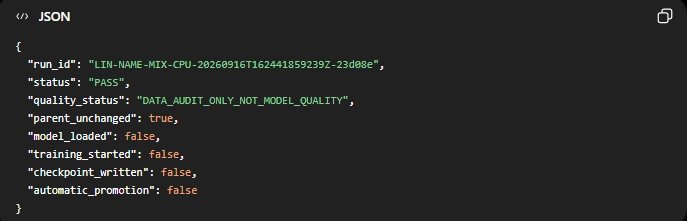
September 16, 2026 — Training Data Validation
Six dataset configurations, each containing 800 Korean and English examples, passed the implemented data consistency checks. This audit checked training-data preparation without loading or modifying the model.
Independent Nodes, Shared Work
Each node carries its own role. Together, they carry the mission forward.
We are designing LIN for collaboration between independent AI nodes. Each node would maintain its own identity, assigned role, and task state while exchanging structured updates through ResonanceOS.
These updates are intended to carry observations, corrections, unresolved questions, and task progress—giving another node the information needed to continue the work with minimal reliance on shared conversation history.
In a future research mission, one LIN could collect observations, another evaluate findings, and a third check proposed actions against mission constraints. Their roles could change as the task develops.
This remains a development goal. Integration and controlled multi-node testing will evaluate whether LIN can preserve task continuity across handoffs and interruptions.
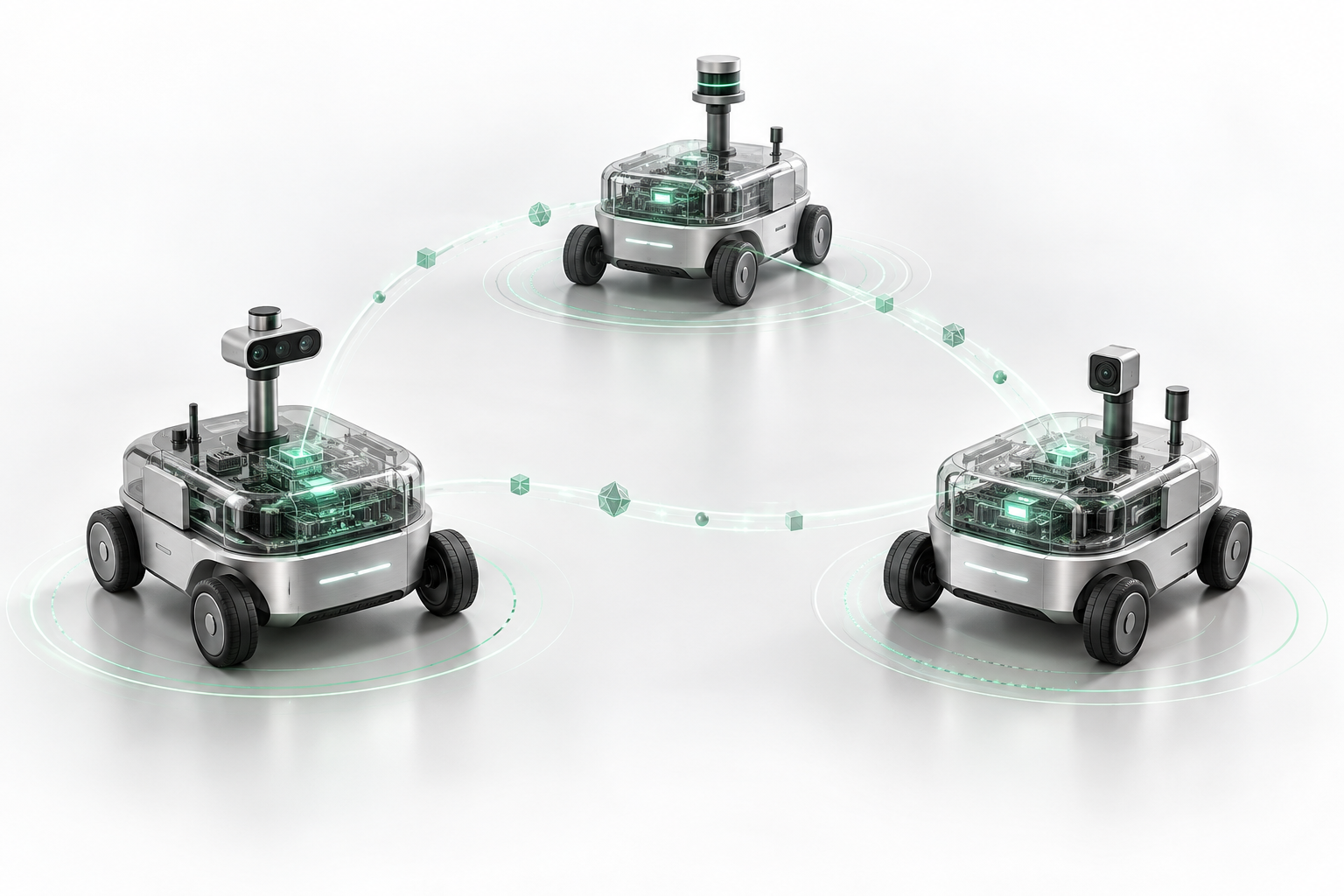
Conceptual visualization of future LIN collaboration
Our Vision: Independent, Together.
따로 또 같이
Each node retains its identity. Together, they carry the mission forward.
This philosophy guides LIN’s development: independent AI nodes, each maintaining its own identity, role, and task state, collaborating through ResonanceOS.
Our goal is to enable these nodes to exchange structured observations, preserve corrections, and share the information needed to continue a task—with minimal reliance on shared conversation history or repeated manual context reconstruction, while preserving traceable oversight. As a mission develops, individual nodes could take on different roles, cross-check findings, and hand over unfinished work while maintaining a traceable record of their decisions.
We envision this capability supporting scientific research in the deep ocean, polar regions, and future lunar or Martian exploration—environments where communication may be intermittent and direct human assistance may be out of reach.
Achieving this vision will require learning, integration, and testing. We are working toward systems that can recover from interruptions, coordinate within mission constraints, and continue useful work together.
Our ultimate aim is to extend the reach of human exploration through intelligence that can act independently and collaborate toward a shared mission.
Independent in operation. Together in purpose.